
Laying the Foundation: Quality Data and Defensible Research
A model can provide outputs that sound right all day long. It can produce crisp summaries, tidy narratives, and a thesis that reads like it belongs in an IC deck. And sometimes it will even be correct. But if you can’t trace the claims back to a source you trust, it doesn’t matter how good it reads.
When it comes to investment research, conviction comes from defensibility and that’s exactly where we started with Strēm.
The first stage of our product development has been focused on building a foundation where AI can’t drift into hallucinations, and where analysts can move faster without compromising the standards their work has to meet.
At BRDGE Insights, Quality Data Comes First.
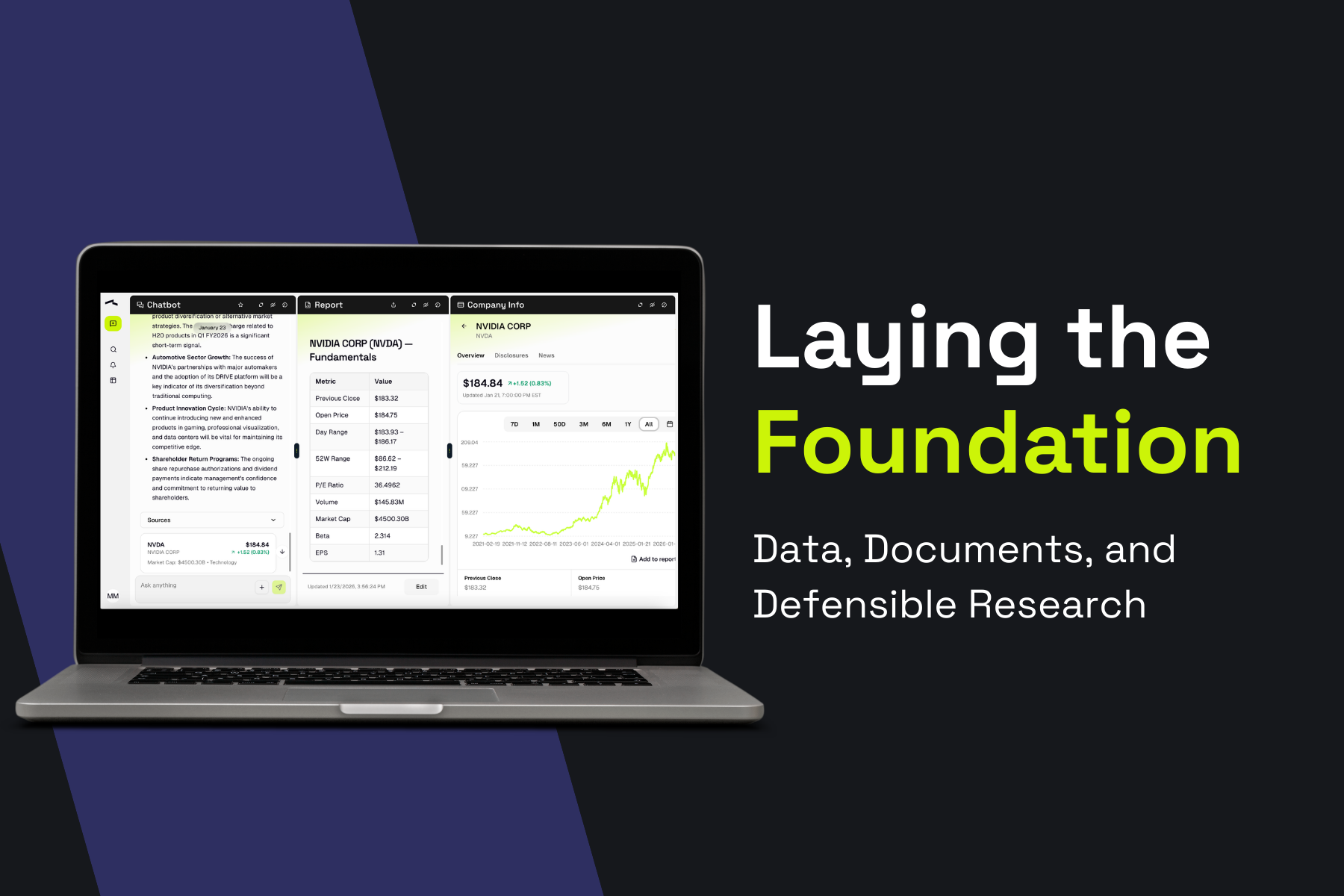
The model isn’t the source.
We built this platform around a simple rule: the model doesn’t get to be the authority.
Instead of letting AI answer from whatever it “knows” (or thinks it knows) from training data, we’ve designed the system so it retrieves information from the trusted sources we’ve connected. The AI’s job is not to invent. It’s to help analysts retrieve, synthesize, and communicate what the underlying data actually says.
We’re building around trusted retrieval.
Most AI tools treat the whole internet (or a generic model brain) as the default data universe. That might work fine for writing captions or brainstorming ideas. It does not work for producing research outputs that need to hold up under scrutiny.
So we’re doing the opposite. We’re defining the universe intentionally.
The system pulls from sources you’ve connected and approved — the same types of trusted inputs that analysts already rely on — and we’re building the workflow so responses stay grounded in that data. That way, when the platform makes a claim, it isn’t doing it because the model “thinks” it’s true. It’s doing it because the system retrieved it from a source you can point to.
This is also what allows teams to build consistency. If your workflow is fed by evidence your team trusts, you aren’t constantly second-guessing the output. You’re using the AI to speed up the work you already do, not replace your judgment with a black box.
Citations aren’t a feature. They’re the whole point.
Source citations are being built into the workflow, not as an add-on, not as something you have to remember to turn on, and not as a “maybe we’ll add it later.” When analysts are pulling together a report or supporting their ratings, they need to know what’s driving the narrative, and they need to be able to validate quickly.
Citations also help reduce back-and-forth friction in teams. They shorten the time between question and conviction. And they make it easier for analysts to stand behind their work because they can connect claims to proof without spending half the day hunting for the original line in a PDF.
The goal isn’t just faster writing and report generation. It’s faster confidence, with receipts.
What’s next
Building the foundation is stage one.
Now we’re focused on making the workflow smoother to aligned with how analysts move from evidence to structured outputs, how reports come together without losing context, and how the handoff to PMs becomes cleaner, faster, and easier to trust.
Here are some of the additional features we’re focused on integrating in the coming months:
Dashboards and watchlists
News integration for additional data input
Notifications for easier monitoring
Coverage management to support ownership, ratings, and long-term conviction
Curious to see Strēm in action? → Request a demo.