
Notifications: Staying Informed Without Living in the Feed
Built for Watchlists Today & Coverage Tomorrow
If you’ve ever covered a name seriously, you already know the hard part isn’t finding information. It’s catching what actually matters before it becomes obvious.
Because markets don’t wait for your calendar to clear. A headline hits, sentiment shifts, a narrative changes shape, and suddenly you’re two steps behind — all because you weren’t sitting inside a feed at the exact right moment.
That’s why we built notifications into Strēm.
Not to add more noise to your day. Not to create another stream of alerts you end up muting after three days. But to give research teams a more sustainable way to stay oriented as the world changes, without forcing anyone to constantly monitor a dozen inputs just to keep up.
Our notifications feature is designed to reduce the friction between “something happened” and “we understand whether it matters to our coverage universe.”
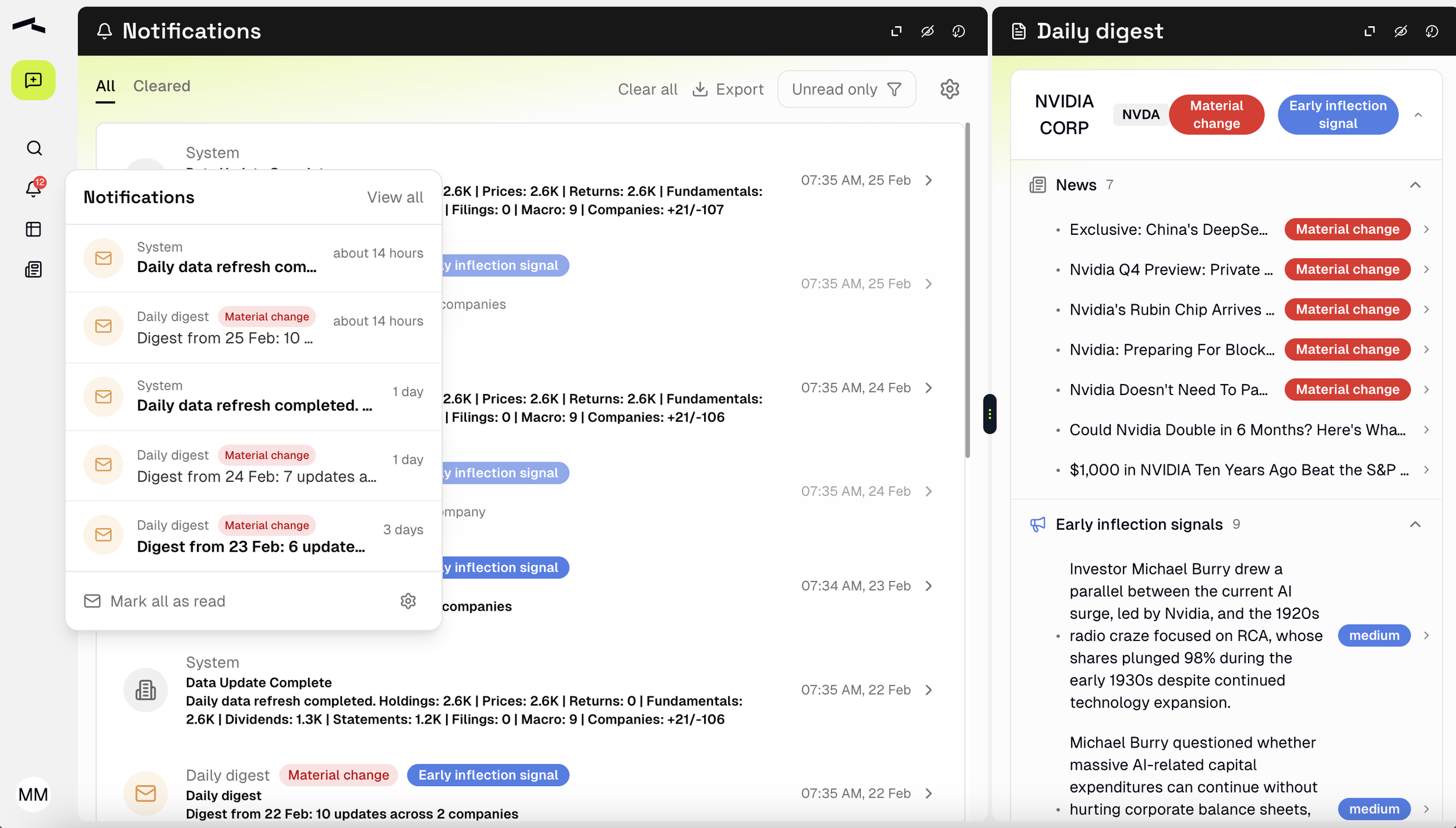
What’s live now: notifications tied to watchlists
Right now, notifications in Strēm are linked to the companies on your watchlist.
Watchlists are often where ideas start, stories develop, and names stay on your radar while you decide what deserves deeper work. If a company is on your watchlist, it usually means one of two things: you’re actively paying attention, or you want to be paying attention — and you don’t want that to depend on memory.
So when new news hits for a company you’re watching, Strēm can notify you. That means you can stay on top of the narrative as it evolves, and decide quickly whether the update is meaningful or just market chatter.
The goal here is simple: stay close to sentiment and story shifts without turning vigilance into a daily chore.
What’s next: notifications connected to coverage management
Watchlist notifications are the first layer, but the bigger vision is coverage-aware notifications.
As coverage management becomes integrated into Strēm, notifications won’t just be “new news exists.” They’ll be connected to how your team is actually tracking the name over time including ratings, conviction, and the evolving research context that supports your view.
That shift is important, because it moves notifications from being ticker-based to being workflow-based.
It’s the difference between: A generic “headline happened” alert and a research-grade signal that’s tied to what your team has already decided matters.
That’s where notifications become a real strategic advantage, not just a feature.
The bigger point: less monitoring, better decisions
We’re not trying to turn Strēm into another place you have to check constantly.
We’re building it so you can spend less time monitoring and more time evaluating.
Notifications are one part of that giving you a way to stay current on the names you care about, keep up with sentiment as it shifts, and respond faster without losing context.
And as we connect notifications to coverage management, that same system becomes even more powerful, because staying oriented won’t just be personal. It will be institutional.
What’s next
Now that the foundational pieces are built and integrated into Strēm — dashboards, watchlists, news, and notifications — it’s time to add our pièce de résistance: coverage management.
This is where ratings live, conviction gets maintained over time, and the entire research workflow starts to feel less like a scramble and more like a system. We’ve got a lot up our sleeve here, and we can’t wait to show you what it unlocks.
For now, if you want to explore what’s already live (and see how it fits together in an actual workflow), book a demo. We’ll walk you through the platform, answer questions, and show you how teams are using Strēm to stay oriented without drowning in noise.
Curious to see Strēm in action? → Request a demo.